How to Pass JFT-Basic as a Beginner: A 60-Day Study Plan
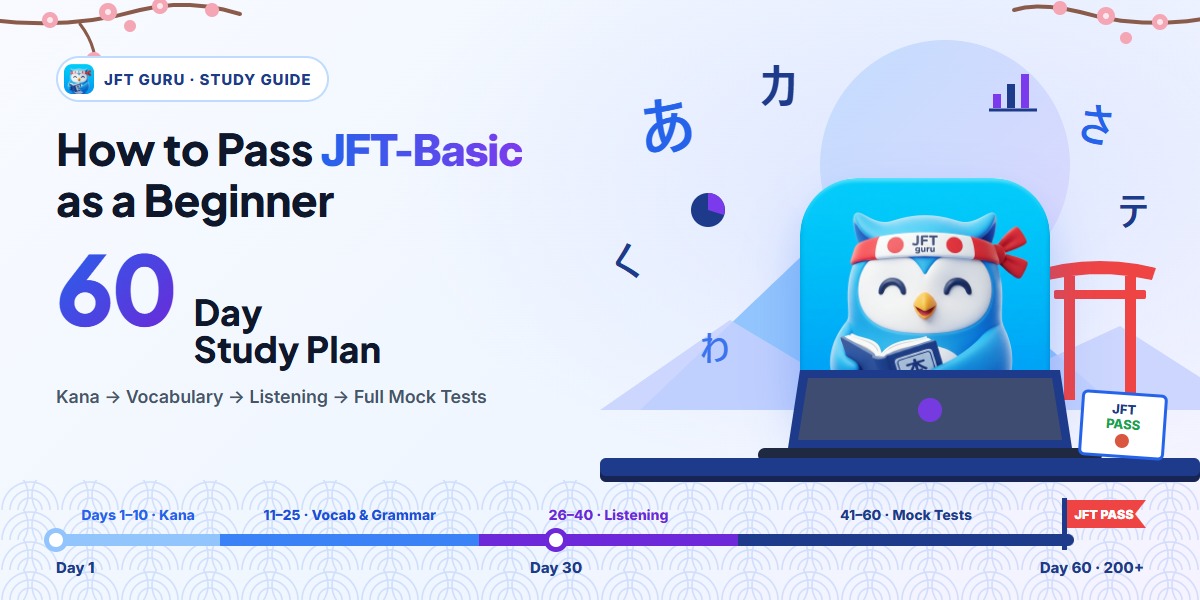
For a beginner preparing for the JFT-Basic, three practical habits deserve a place in the study plan: attempting mock tests, practicing listening and learning to understand kanji in the context of questions. They serve different purposes. Mock tests reveal gaps and familiarize learners with question formats; listening practice develops comprehension of spoken Japanese; and contextual kanji study helps learners understand written words and instructions.
This 60-day road map shows how a beginner can organize those activities, review mistakes and become more familiar with a computer-based test (CBT). Sixty days is a planning period, not a promise of passing. Progress depends on starting proficiency, study time, learning resources and performance on practice tasks.
1. Establish your starting point
Before following a timetable, record what you can already do. A short diagnostic exercise can help identify the areas that need attention. Avoid treating one score as a complete measure of readiness; note which questions were missed and why.
|
Area |
Possible beginner starting point |
What to record |
|
Hiragana and katakana |
Some characters may be unfamiliar |
Characters read correctly and those needing review |
|
Vocabulary |
Limited everyday Japanese |
Known words and recurring unknown words |
|
Kanji |
Little prior recognition |
Common words recognized in context |
|
Listening |
Spoken phrases may be difficult to follow |
Whether the main topic and key details are understood |
|
Mock tests |
Question format may be unfamiliar |
Baseline score, test source and date |
|
CBT familiarity |
Limited experience answering on-screen questions |
Comfort using the interface and navigating questions |
2. The three core preparation activities
Mock-test practice: attempt, review, adjust
Mock tests are useful when learners use them as diagnostic tools rather than simply collecting scores. After each attempt, review every incorrect answer. Classify the cause: unfamiliar vocabulary, missed listening information, difficulty recognizing kanji, misunderstanding the question, or rushing.
Use practice materials that clearly identify their source and are suitable for the current JFT-Basic format. Keep the date, practice set, conditions and result in a simple log. Scores from different providers may not be directly comparable, so avoid drawing strong conclusions from small changes.
Listening: listen, check, listen again
A practical listening cycle has three steps. First, listen without reading a transcript and try to identify the topic and important details. Second, check the transcript, mark unfamiliar expressions and compare them with what you heard. Third, listen again and answer a few comprehension questions. This makes review more purposeful than playing the same audio without checking understanding.
Kanji: learn useful words in context
Beginners do not need to postpone all practice until they have memorized a large list of kanji. Start with common words and learn how they appear in everyday sentences and questions. The goal is to recognize the word and understand its role in context, not merely to recall an isolated character.
|
Japanese |
Reading |
Meaning |
|
時間 |
じかん (jikan) |
time |
|
今日 |
きょう (kyō) |
today |
|
明日 |
あした (ashita) |
tomorrow |
|
電車 |
でんしゃ (densha) |
train |
|
会社 |
かいしゃ (kaisha) |
company |
|
駅 |
えき (eki) |
station |
|
休み |
やすみ (yasumi) |
rest / day off |
|
名前 |
なまえ (namae) |
name |
3. A 60-day roadmap
Use this as a flexible example. Adjust the emphasis when your practice log shows a persistent difficulty.
|
Period |
Focus |
Suggested work |
|
Week 1 | Days 1–7 |
Foundations |
Study hiragana and katakana, practise greetings and take a short diagnostic exercise. |
|
Week 2 | Days 8–14 |
Vocabulary and short listening |
Build everyday vocabulary, listen to short dialogues and review basic sentence patterns. |
|
Week 3 | Days 15–21 |
First structured mock tests |
Attempt suitable practice questions and record the reasons for incorrect answers. |
|
Week 4 | Days 22–28 |
Listening and contextual kanji |
Practise listening regularly and learn kanji through familiar words and sample questions. |
|
Week 5 | Days 29–35 |
Targeted practice |
Use the error log to choose weak topics; practise them separately before trying similar questions. |
|
Week 6 | Days 36–42 |
CBT familiarity |
Practise reading on-screen questions, selecting answers and working under timed conditions. |
|
Week 7 | Days 43–49 |
Correction and revision |
Revisit recurring mistakes, repeat difficult listening exercises and review learned vocabulary. |
|
Week 8 | Days 50–56 |
Full practice sessions |
Complete practice sessions under consistent conditions, then analyze the results. |
|
Final four days | Days 57–60 |
Consolidation |
Review familiar material, check official test arrangements and avoid overloading the final days. |
4. Track progress without inventing a success story
A credible preparation record uses dated results from actual practice. Record the practice source and conditions alongside the score. Do not combine scores from unlike tests into a single trend or describe a practice result as an official examination result.
|
Checkpoint |
Listening |
Reading / language tasks |
Next action |
|
Baseline |
Enter actual result |
Enter actual result |
Identify the main gaps |
|
End of week 2 |
Enter actual result |
Enter actual result |
Review foundational errors |
|
End of week 4 |
Enter actual result |
Enter actual result |
Choose targeted practice |
|
End of week 6 |
Enter actual result |
Enter actual result |
Practise CBT conditions |
|
End of week 8 |
Enter actual result |
Enter actual result |
Review consistency and remaining gaps |
5. Turn each mistake into a next step
-
Vocabulary: write the word, meaning and a short example; review it later.
-
Listening: replay the relevant section, check the transcript and identify the missed detail.
-
Kanji: learn the complete word and its meaning in the sentence rather than memorizing a character without context.
-
Question comprehension: underline or note what the question is asking, then explain why the selected answer fits.
-
Time management: practice with a timer after you understand the question types; do not sacrifice careful review during learning sessions.
6. A sample daily study session
The following two-hour example can be shortened or split into smaller sessions.
|
Activity |
Time |
Purpose |
|
Vocabulary and kanji |
30 minutes |
Learn useful words and recognize them in context |
|
Listening practice |
40 minutes |
Listen, check the transcript and listen again |
|
Mock-test questions |
35 minutes |
Practise question formats and apply what you have learned |
|
Mistake review |
15 minutes |
Record errors and choose the next practice focus |
7. Prepare for the computer-based test
The JFT-Basic is delivered as a computer-based test. Practising on a computer can make the format feel more familiar. Use the official guidance for current test procedures and requirements; do not rely on old screenshots or informal descriptions if the official instructions differ.
-
Read the on-screen instructions carefully before answering.
-
Practice selecting answers with a mouse or the input method available to you.
-
Become comfortable reading Japanese on a screen.
-
Use timed practice to develop a steady pace.
-
If a question contains an unfamiliar word, use the surrounding sentence to understand what is being asked.
-
Confirm the current appointment, identification and test-day instructions through the official test provider.
8. Student perspectives from JFT Guru
The following student experiences describe different challenges learners faced while preparing for the JFT-Basic. The statements have been edited for grammar and clarity while preserving the experiences provided.
Shree Krishna Khadka - Listening and conversation practice
“JFT Guru helped me a lot in preparing for and passing my JFT-Basic exam. I had failed the exam twice. After that, I started practicing listening and conversation using JFT Guru. I became a regular learner and maintained a 32-day study streak. The following month, I passed the exam. JFT Guru helped me a lot throughout my preparation.”
Rajesh Karki - Vocabulary and kanji practice
“I had failed the exam before. For my next preparation, I used JFT Guru’s vocabulary materials and a kanji app to strengthen my understanding. With that practice, I was able to pass the exam.”
Sunita Paudel - Becoming familiar with the CBT format
“I was afraid of the computer-based test (CBT) format. My consultancy provided me with realistic CBT practice through JFT Guru. After attempting mock tests and seeing my results, I became more familiar with the format and felt less afraid of taking the exam.”
Frequently asked questions
Can a beginner prepare for JFT-Basic in 60 days?
A 60-day plan can provide structure, but it cannot guarantee a pass. The appropriate pace depends on the learner’s starting point, available study time and progress.
Should I practice mock tests every day?
Not necessarily. Use mock tests at a pace that leaves time to review mistakes and study weak areas. Short topic-based exercises can be more useful on some days.
Is listening practice important?
Listening is one of the skills assessed in practical Japanese communication. Regular, reviewed listening practice can help learners identify spoken information and common expressions.
Do I need to memorize every kanji first?
A beginner can learn useful kanji and vocabulary in context while continuing to practise questions. Follow the official test scope and use unfamiliar questions as learning opportunities.
Does a high mock-test score guarantee that I will pass?
No. Practice materials vary, and a mock-test score is not an official result. Use multiple practice sessions and consult current official information about the examination.
Final takeaway
A useful JFT-Basic preparation plan connects practice with review. Attempt mock-test questions to find gaps, use listening exercises to build comprehension, and learn kanji through words and questions. Track what you actually do and how your results change. A 60-day schedule can guide that work, but a genuine student success story must be built from verified records rather than assumed scores or invented quotations.
Frequently Asked Questions
Can a beginner prepare for JFT-Basic in 60 days?
A 60-day plan gives you structure, but it cannot guarantee a pass. The right pace depends on your starting level, available study time and progress.
Should I take mock tests every day?
Not necessarily. Take mock tests at a pace that leaves time to review your mistakes and study weak areas. On some days, short topic-based exercises are more useful.
Is listening practice important for JFT-Basic?
Yes. Listening is one of the skills the test assesses. Regular practice where you check the transcript and listen again helps you pick up spoken information and common expressions.
Do I need to memorize every kanji first?
No. You can learn useful kanji and vocabulary in context while you practice questions. Follow the official test scope and treat unfamiliar questions as learning opportunities.
Does a high mock-test score guarantee that I will pass?
No. Practice materials vary, and a mock-test score is not an official result. Use several practice sessions and check current official information about the exam.
How can I get used to the computer-based test?
Practice answering on a computer, read the on-screen instructions carefully and use timed practice. JFT Guru's mock tests let you practice in a CBT-style format.
Read More Articles
.png)
.webp)

Help others learn!
Share this article with your friends and community.
Written by Raju Neupane
Japanese Language Educator at JFT Guru, providing high-quality JFT Basic study materials, mock test guides, and exam preparation strategies for Nepali students.