Learning Basic Japanese for JFT-Basic: A Realistic Study Plan
Plenty of guides promise to get you through JFT-Basic in a week. This one will not, because it is not true for most people - and booking an exam on that assumption wastes a fee.
What follows is an honest order of work: what to learn first, why, and how to tell when you are actually ready.
How long it really takes
JFT-Basic is pitched at A2, roughly JLPT N4. Starting from no Japanese at all, that is normally months of consistent study, not days. If you already read kana and know some vocabulary, a focused few weeks can be enough to close the gap.
A short, intense week can genuinely help - but as a final revision push before an exam you were nearly ready for, not as your entire preparation.
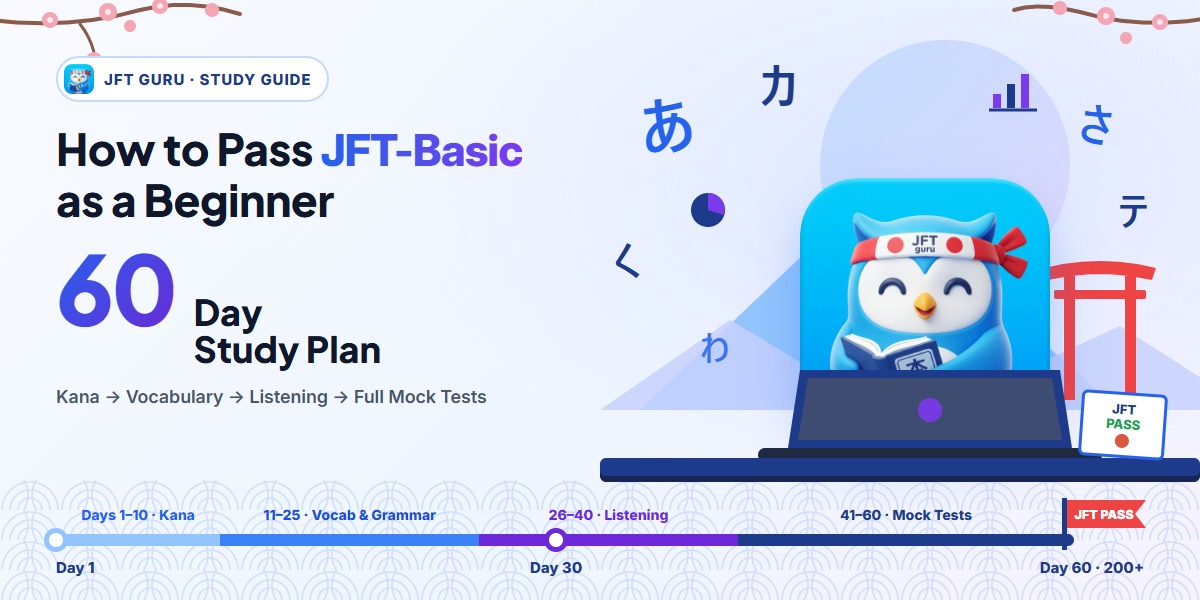
Step 1: Kana first, and completely
Learn hiragana and then katakana to the point of instant recognition. Not "I can work it out" - instant.
This comes first because everything else depends on it. Every section of the test assumes you can read kana without effort, and hesitating over characters costs you time you need for the actual questions. Katakana matters more than beginners expect: loanwords are everywhere in workplace Japanese.
Step 2: Vocabulary by situation, not alphabetically
JFT-Basic tests practical Japanese, so learn words grouped by the situations they appear in: work, shopping, transport, time and dates, numbers and counters, directions, health.
Grouping by situation beats alphabetical lists because the test asks you to pick the right word in context, and because related words reinforce each other.
Our JFT topic vocabulary tool organises words this way.
Step 3: Everyday expressions
The Conversation and Expression section asks what a person would naturally say in a situation - greetings, requests, apologies, permission, refusals, workplace exchanges.
This is the section candidates most often neglect, because it does not reduce to a memorisable list. It is also one of the quickest to improve once you start paying attention to it, since a relatively small set of patterns covers most of what is tested.
Step 4: Listening, every day
Listening cannot be crammed. Ability here is built by frequency, not by long sessions - fifteen minutes daily beats two hours once a week.
Work with audio at natural speed rather than slowed recordings. The test does not slow down, and adjusting to real pace is most of the difficulty.
Step 5: Reading practical text
Reading Comprehension uses signs, notices, short messages and simple instructions - not literary passages. Practise skimming for the specific piece of information a question asks for, rather than translating everything.
Step 6: Full timed papers
Once the four areas above are in place, switch to full-length timed mock tests. This is the step people skip, and it is the one that most reliably changes outcomes.
A full paper tells you three things nothing else will: whether you can hold concentration for 60 minutes, whether your pace is sustainable, and which section is actually costing you marks.
Start with Mock Test Set 1, then work through the other sets.
How to know you are ready
The exam is scored 10-250, and the SSW visa needs 200 or above (A2.2). Since August 2026 the test also reports A1 and A2.1 - and A2.1 is not a pass.
The signal to book is consistency, not a single good score: several different full papers, all comfortably above your target. One good result is as likely to be a favourable paper as genuine readiness.
A sustainable weekly rhythm
- Every day: 15-20 minutes of listening, plus vocabulary review.
- A few times a week: a focused session on your weakest section.
- Once a week: one full timed mock test, reviewed properly afterwards.
Reviewing a paper matters as much as sitting it. For every wrong answer, work out whether it was a word you did not know, a detail you missed, or a pace problem - those need three different fixes, and treating them all as "study more" wastes time.
Read More Articles
.png)
.webp)
Help others learn!
Share this article with your friends and community.
Written by Raju Neupane
Japanese Language Educator at JFT Guru, providing high-quality JFT Basic study materials, mock test guides, and exam preparation strategies for Nepali students.