Free JFT Basic Mock Tests: How to Practise Before Exam Day
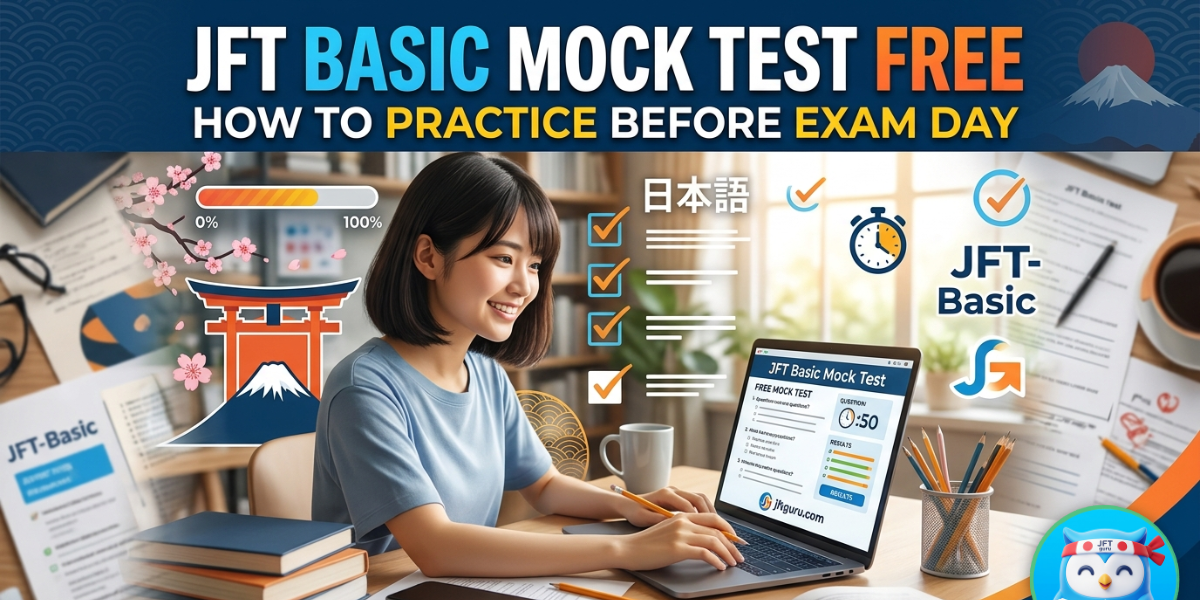
Most people preparing for JFT-Basic study vocabulary and then hope for the best on exam day. The candidates who pass comfortably do something different: they sit full-length, timed papers until the format stops being a surprise. This guide explains how to do that well.
Why mock tests matter more than more vocabulary
JFT-Basic is a 60-minute computer-based test of about 50 questions across four sections. Two things fail candidates who actually know enough Japanese:
- Pace. Sixty minutes across four sections is not generous. If you meet the timing for the first time on exam day, you will lose marks you did not need to lose.
- The interface. It is a computer-based test. Audio plays on a schedule you do not control. Candidates who have only ever studied on paper lose time simply working out the mechanics.
A mock test fixes both, and neither can be fixed by another vocabulary list.
How to take a mock test properly
- Sit the whole paper in one go. A full 60 minutes, no pausing. Stopping halfway tells you what you know, but not whether you can sustain concentration - which is the thing actually being tested.
- Time it honestly. No looking things up, no restarting a listening clip. The value of the exercise is entirely in its realism.
- Review every wrong answer. The score itself is not the useful part. The useful part is why each mistake happened - misread word, missed audio detail, or genuinely unknown grammar. Those three problems have three different fixes.
- Look for patterns across attempts. One bad listening section is noise. Three in a row is a signal telling you where your remaining study time should go.
Practise all four sections
The four sections are Script and Vocabulary, Conversation and Expression, Listening Comprehension and Reading Comprehension.
Candidates reliably under-practise Conversation and Expression, because it does not reduce to a memorisable list - it asks what a person would naturally say in a situation. It is also one of the easier sections to improve quickly once you start paying attention to it.
Reading your mock score honestly
The real exam is scored from 10 to 250 points, and the SSW visa requires 200 or above, reported as A2.2. Since August 2026 the test also reports A1 (145-174) and A2.1 (175-199).
That last point deserves emphasis, because it is a new way to be disappointed: A2.1 is not a pass. It is close, and it is genuine progress, but it does not qualify you for the visa. Only 200 and above does.
A mock test score is an indicator, not a prediction. Treat consistency as the signal - scoring comfortably above your target across several different papers means considerably more than one good result.
How many should you take?
There is no magic number, and any specific figure you see quoted is invented. A more useful rule: keep taking full papers until your score stops improving and starts holding steady above your target. That plateau is the real readiness signal. For someone starting from very little Japanese it takes a good many papers; for someone already near the level it may take only a few.
What a mock test cannot tell you
Be clear about the limits. A mock test replicates format, timing and question style. It does not replicate exam-centre conditions, ID checks, or nerves, and no practice score guarantees a real result. Use it to find weaknesses while you still have time to fix them - that is what it is genuinely good for.
Start with a full paper
If you have not sat a timed paper yet, start there rather than with more study - you will learn more in 60 minutes than in a week of vocabulary drilling, because you will find out what you actually cannot do.
Take JFT Basic Mock Test Set 1 free, then work through the full set of mock tests. If you are preparing in Nepal, our JFT Basic Nepal guide covers booking and centres as well.
Frequently asked questions
Are the mock tests free?
Sets 1 and 2 are free to take with an account. The remaining sets are part of a premium plan.
Do mock tests match the real exam exactly?
They follow the same four-section structure, the same 60-minute format and the same question types, including audio. They are not the real questions - nobody outside the Japan Foundation has those.
I scored A1 on a mock test. Should I book the exam?
Not yet. A1 is 145-174 points and the visa needs 200. Keep practising until you are scoring consistently above 200, then book.
How soon do I get real exam results?
On the day of the test, with official notification within 5 business days. Results do not expire.
Read More Articles
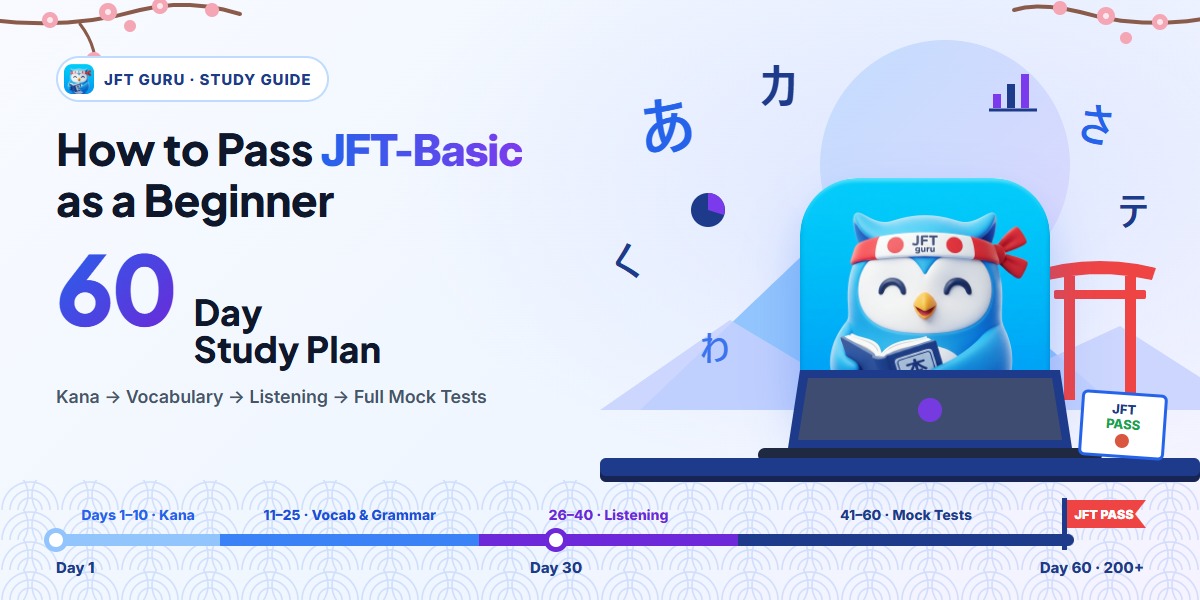
.png)
.webp)
Help others learn!
Share this article with your friends and community.
Written by Raju Neupane
Japanese Language Educator at JFT Guru, providing high-quality JFT Basic study materials, mock test guides, and exam preparation strategies for Nepali students.